
TDCJ Releases for Guadalupe Cases
A felony conviction in Guadalupe County can lead to confinement at a TDCJ prison or state jail elsewhere in Texas. The TDCJ statewide unit directory did not show a unit in Guadalupe County at the research date. This does not mean people sentenced in the county remain at the local jail. After transfer and state intake, their records move into the statewide system.
A disappearance from the Guadalupe County jail should not be called a TDCJ release. It may be a transfer into state custody, and the TDCJ result may take time to appear after intake. Later, the person may leave institutional confinement on parole, mandatory supervision, or discharge. Those labels have distinct effects. Parole and mandatory supervision keep the person under TDCJ Parole Division authority, while discharge means the sentence has ended under the TDCJ definition.
| Status or event | Meaning | Correct record |
|---|---|---|
| County-to-state transfer | Custody continues after the county jail episode | County transfer record, then TDCJ intake |
| Parole | Conditional release from prison under supervision | TDCJ offender detail and BPP/TDCJ status |
| Mandatory supervision | Conditional statutory release for an eligible person | TDCJ status and release certificate |
| Discharge | The correctional sentence ends | TDCJ history or discharge record |
Search TDCJ Release Status
The official TDCJ offender search is the main online route for state custody and release history. The form accepts Last Name, First Name, TDCJ Number, SID Number, Gender, and Race. A TDCJ or SID identifier is safer than a name-only match. Compare the conviction county, offenses, and other lawful identifying fields before deciding that a result belongs to the right person.
- Enter the TDCJ number or SID when known. Otherwise use the full name and narrow only with accurate fields.
- Open the detail and read each status and date label exactly as shown.
- Separate unit location from release location and projected date from scheduled or actual release.
- Record when the result was checked, because TDCJ warns that public data is at least 24 hours old.
- Use the email or telephone fallback if the result is unclear or a historical state record is absent.
The county live roster is never the fallback for a person already accepted into TDCJ. It records a different custodian and episode. Likewise, IVSS Counties applies to the Guadalupe jail layer, while state-prison IVSS and TDCJ offender information apply after state intake.
TDCJ Date Labels Explained
TDCJ uses several date concepts, and reading them as synonyms can create a false release claim. Parole eligibility is the date a person may be considered for parole. It is not an order to release. The Projected Release Date is a Classification and Records calculation whose meaning depends on the offense date and mandatory-supervision eligibility. It may change as time calculations or legal events change.
A Scheduled Release date and location appear when processing has advanced, but TDCJ cautions that they can change without notice, even on the scheduled day. A favorable Board of Pardons and Paroles decision also does not prove physical departure. Residence approval, required programming, certificate preparation, audit, and eligibility issues can remain. A Discharge Date, by contrast, marks the end of the sentence and release from incarceration, parole, mandatory supervision, or community supervision under the state's definition.
- Projected Release Date
- A computed TDCJ date, not proof of actual release.
- Scheduled Release
- A planned date and location after advanced processing, still subject to change.
- Parole eligibility
- The point at which review may occur, with no promise of approval.
- Discharge
- Completion of the correctional sentence and its supervision.
The separate Guadalupe County inmate release date page addresses calculations and change factors in depth. On this facility page, preserve TDCJ's exact label and check again after the event.
TDCJ Release Information Contacts
When the online result is unclear, TDCJ provides email and telephone routes. The no-charge email information service asks for the full name and seven-digit TDCJ number. If the number is unknown, give the exact date of birth, or approximate age and county of conviction. Put the person's name in the subject line.
Email: pia@tdcj.texas.gov
General information: 936-295-6371 or 800-535-0283
Telephone hours: weekdays, 8:00 a.m.-5:00 p.m.
Pre-vote BPP status: 844-512-0461
Post-approval Parole Division status: 512-406-5202
The response may include the TDCJ number, location, conviction offense, prior and current incarceration information, and Projected Release Date. TDCJ explicitly says this email route does not provide photographs or Social Security numbers. A broader request for an existing release certificate, time calculation, or discharge document belongs through the agency's official public-information process.
The successful manifest image below comes from that official TDCJ email fallback page.
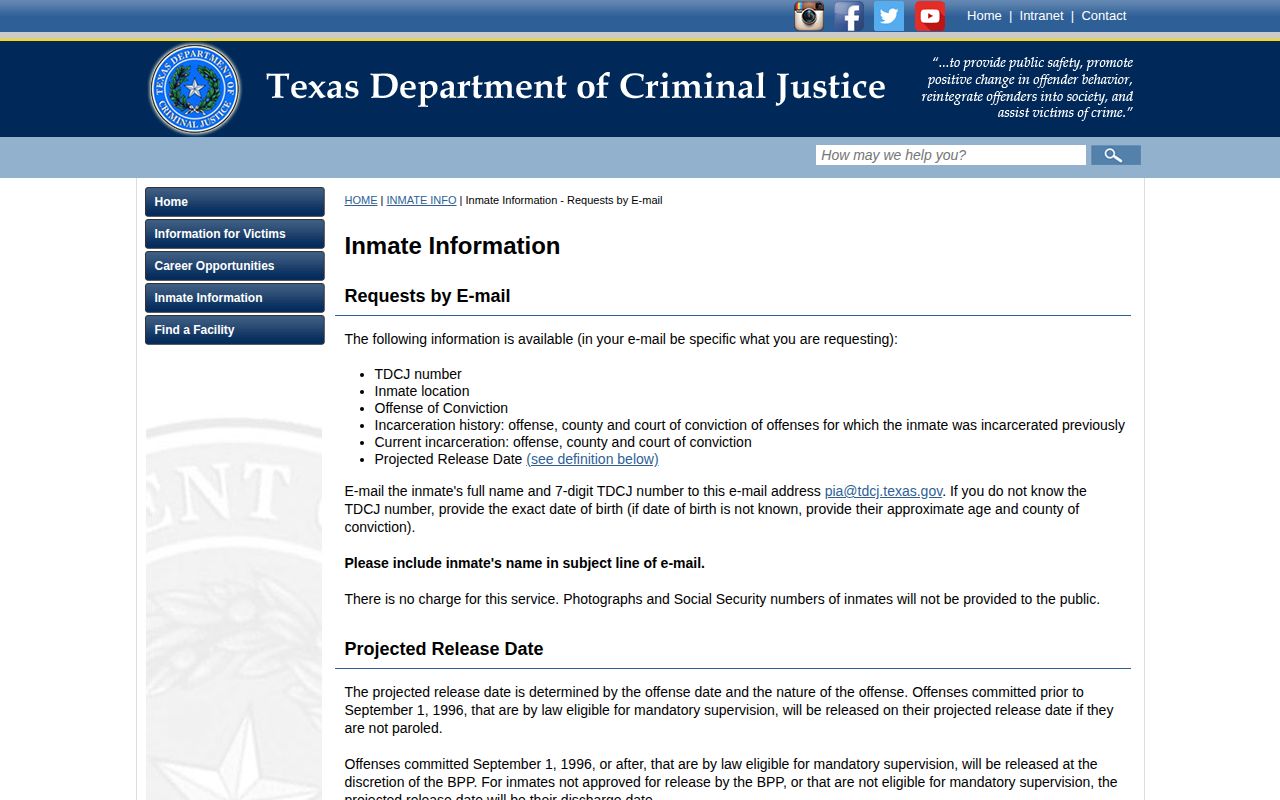
It confirms both the alternative access channel and the need to treat a projected date as a defined calculation.
No Guadalupe TDCJ Unit
The TDCJ directory finding is locally important. There is no state prison or state jail physically listed in Guadalupe County, yet a Guadalupe conviction can still place someone anywhere in the statewide network. Families should identify the current unit in the offender detail and verify it before travel. A unit can change through transfer, treatment placement, release processing, or another operational move.
The successful manifest image is taken from the official statewide unit directory.
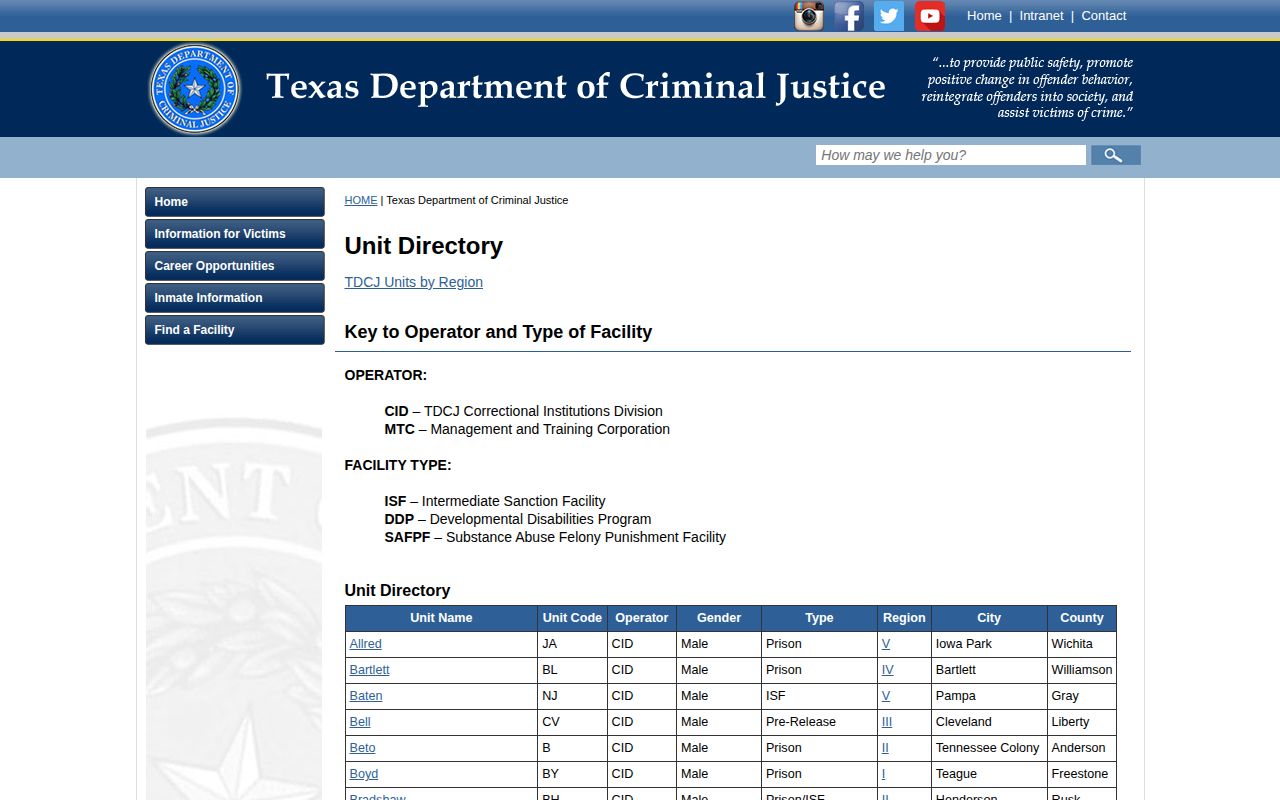
The directory places the custody question at the statewide level instead of implying that Guadalupe County operates a TDCJ prison.
A county release to TDCJ is a transfer, not a return to the community. Obtain the Guadalupe County release or transfer sheet if the handoff itself matters. Then use the state record for intake, prison location, release dates, parole, and discharge. Keeping both episodes preserves the chain of custody.
Note: TDCJ tells relatives to contact the unit before pickup because scheduled details and public records can change.
TDCJ Review and Physical Release
The Board of Pardons and Paroles and TDCJ have separate responsibilities. The Board votes on parole and mandatory-supervision cases. The TDCJ Parole Division and Review and Release Processing unit handle the bridge from an approval toward release and later supervision. Ordinary parole review does not create a public courthouse-style hearing calendar, so person-specific status and result channels matter more than searching for a hearing date.
The official Review and Release Processing page explains this post-vote work. A favorable result can still depend on a verified residence, a program, the release certificate, an audit, and the lawful eligibility date. The public offender record can show Scheduled Release fields once the process is advanced, but the agency warns those details may change.
After release to Guadalupe County, the Seguin District Parole Office may be the assigned supervision office if the approved geography calls for it. Its existence does not prove assignment. Confirm the release and status first, then use the office directory for routing. Probation through Guadalupe CSCD remains a separate court-supervision system.
TDCJ Release Logistics
TDCJ's official release guidance contains practical details that differ from county-jail release. State release location can be the Huntsville Unit, the Gatesville area, a regional release site, or another place directed by the agency. The actual Scheduled Release location in the person-specific record should control. No Guadalupe County unit exists from which to assume a local pickup.
State guidance addresses clothing, eligible gate money, trust-fund balance, transportation assistance, and release-day contact. Eligibility and amount depend on the governing rules and record, so those items should not be promised from a general page. The prudent step is to confirm the current location and instructions with TDCJ before traveling.
A detainer can also redirect the event. Release from TDCJ institutional custody may lead directly to another state, county, federal, or immigration custodian. That is not unrestricted community release. Preserve the destination field, ask the receiving agency for its record, and do not rely solely on the word “released” in one system.
The Guadalupe County released inmates search provides the county, state, and federal handoff framework when the last known custodian is uncertain.