
Read a Guadalupe Release Record
“Released” does not identify one legal outcome. A person can leave the Guadalupe County Adult Detention Center after a cash, surety, or personal bond; a judge's order; completion of a county sentence; or transfer to another custodian. A Texas Department of Criminal Justice record may instead describe parole, mandatory supervision, or full discharge. A federal Bureau of Prisons result covers federal custody only. Preserve the system, booking episode, and stated status before drawing a conclusion.
The strongest county record connects the person's recorded name and booking number to the booking date, actual release date and time, release type or disposition code, authority for release, cause number, and any receiving agency. A transfer destination matters because leaving the Guadalupe jail does not necessarily mean returning to the community. Bond also does not mean dismissal or acquittal. It explains why pretrial confinement ended while the criminal case continues.
| Field | What it establishes |
|---|---|
| Booking number and dates | The correct jail episode rather than an older arrest or same-name person |
| Actual release time | When physical county custody ended, not merely when an order was signed |
| Release code and authority | Bond, time served, court order, sentence completion, transfer, or another recorded outcome |
| Receiving agency | Whether custody continued with TDCJ, another county, federal authorities, or another custodian |
| Cause number | The bridge to the court docket, judgment, bond action, and later disposition |
Texas records schedules provide a useful fallback when no online archive exists. Local Schedule PS makes the county jail register permanent and calls for release or transfer information in its minimum content. Booking-in/out forms and commitment, transfer, and release orders generally have a minimum retention of release or transfer plus two years. Retention does not guarantee online publication or unrestricted disclosure, but it supports a focused request to the records custodian.
Request the Existing Jail Record
Guadalupe County does not publish a verified historical release archive in the official channels reviewed. Call Jail Records at 830-303-6342, extension 2239, for a narrow status question. When proof matters, send a written request to the Guadalupe County Sheriff's Office Records Division at 2617 North Guadalupe Street, Seguin, Texas 78155, email so.openrecords@guadalupetx.gov, or use the official request form. The published office hours are 8:00 a.m. to 5:00 p.m. Monday through Friday, excluding county holidays.
- Give the full recorded name, useful aliases, approximate booking and release dates, and a booking or cause number if known.
- Ask for an existing booking/release sheet for that episode, including actual release date and time, disposition code or description, and receiving agency if maintained and public.
- Request the related bond record or booking photograph only when needed. Ask for an electronic copy and a fee estimate instead of assuming a fixed photo charge.
- If part is withheld, ask the custodian to identify the applicable legal basis. Do not ask staff to create a custom analysis or answer open-ended questions.
The Texas Public Information Act, Government Code Chapter 552, governs access but also recognizes exceptions. Juvenile records, sealed or expunged material, protected identifiers, medical information, safety-sensitive content, and records under a legal exception may be restricted. The county says ordinary requests are processed promptly and identifies a ten-business-day written-notice framework when information cannot be produced within ten business days; that is not a promise that every request will finish in ten days.
Find a Released Guadalupe Inmate
Start with the last known custodian. A current-custody roster is not a release history, and disappearance alone leaves several possibilities open: community release, transfer to TDCJ, transfer to another county or agency, a data delay, or a legally restricted record.
- For a Guadalupe jail booking, search the named person in the county's IVSS Counties channel and preserve the exact event wording and date. “Transfer” means custody continued.
- Call Jail Records and request the release sheet for the specific booking. This is the best source for actual departure time and destination.
- Open the Tyler judicial Public Access case. Use the County Clerk for misdemeanor matters and District Clerk for felony matters to read the docket, bond action, judgment, or dismissal.
- If the county record shows a state transfer, switch to the TDCJ offender search after allowing for intake and working-day data lag.
- For federal or immigration custody, use BOP, ICE, or U.S. Marshals channels only when the jurisdiction fits.
The Released Last 24 Hours guide handles same-day verification when no official feed exists. The Inmate Release Date page explains why a projected state date is not proof of departure.
Texas Offender Search After Transfer
The TDCJ Inmate Search is appropriate after a Guadalupe detainee enters state custody and for state-prison release history. It is not a county-jail archive. Search by TDCJ or State Identification number whenever possible; name-only matches need careful identity checks.
| Search field | Use |
|---|---|
| Last and first name | Broad lookup; confirm against identifiers and conviction county |
| TDCJ number | Seven-digit state corrections identifier |
| SID number | Texas criminal-history identifier |
| Gender and race | Narrowing fields, not identity proof by themselves |
TDCJ warns that public data is updated on working days and is at least 24 hours old. Read each label literally. Parole eligibility is only the earliest legal consideration point. Projected Release Date is a calculation if parole does not occur sooner. Scheduled Release date and location indicate advanced processing but can change. A favorable Board result is not physical release. A discharge date describes sentence completion under the agency definition.
If the online record is unclear, email pia@tdcj.texas.gov with the full name and TDCJ number, or exact date of birth when the number is unknown. TDCJ describes this as a no-charge information route and says photographs are not supplied. General information numbers are 936-295-6371 and 800-535-0283 during weekday business hours.
County Releases Without a Feed
No distinct official rolling 24-hour or 72-hour Guadalupe County release list was found. The Sheriff's “Records Search” leads to the Tyler judicial portal, which is valuable for court events but is not a jail release feed. No official publication window, refresh schedule, archived fields, photograph behavior, or roster-retention period should be inferred.
For a quick event, use IVSS Counties, then verify through Jail Records. For a three-day period, ask whether GCSO already maintains a release report for the stated dates. If it does not, request the named booking records rather than requiring staff to create a new analytic list. The Released Last 72 Hours guide explains that weekend and holiday research path.
Bond, Clothing, and Property
Guadalupe's official jail information distinguishes cash, surety, and personal bonds. A cash bond deposits the set amount; a surety bond uses a bondsman; a personal bond can release the accused without posting the face amount. Guadalupe operates a Bail Bond Board, so bonding companies must be licensed. None of these outcomes decides the criminal charge. Follow the cause number into the continuing court case.
The jail also publishes unusually practical release logistics. A released person without proper attire receives indigent clothing. Property pickup is available from 8:00 a.m. to 4:00 p.m. weekdays, except county holidays, and requires an inmate-signed release form plus the recipient's state identification. Property left after a transfer can be destroyed or donated after 30 days if arrangements are not made. This 30-day property rule is not a release-record retention rule.
Roster Exit Is Not Release
GCSO describes the Adult Detention Center as a 598-bed facility with about 8,000 bookings annually and an estimated 3,600 transfers to various courts. Those are attributed workload figures, not unique-person counts or community-release totals. The transfer volume is a concrete reason not to translate disappearance from a custody view into “released.” Follow the receiving agency recorded on the release or transfer sheet.
Two Clerks Preserve the Case
Release research in Guadalupe County crosses two local court custodians. The County Clerk and County Courts at Law handle misdemeanor records; the District Clerk and district courts handle felony records. Both lead to durable case information after a live jail entry disappears. The court record can explain a bond order, dismissal, plea, judgment, jail credit, probation order, or warrant, but the jail sheet remains the source for the physical departure time.
The official County Clerk page lists cccourts@guadalupetx.gov and 830-303-8861. The District Clerk page lists dccourts@guadalupetx.gov and 830-303-8875. Match the name and cause number before treating a docket event as belonging to the same person.
The District Clerk's local expunction guidance also identifies an unusually broad recipient list, including the Sheriff, clerks, magistrate, Adult Probation, statewide court administration, TDCJ-CJAD, and DPS. An expunction under current Code of Criminal Procedure Chapter 55A can explain why a once-visible record no longer appears. Do not route around an order through copied aggregator data. Nondisclosure under Government Code Chapter 411 is different and can preserve specified official access.
Verify Parole or Probation
Texas separates parole decisions, parole supervision, and county probation. The Board of Pardons and Paroles decides parole and mandatory supervision. TDCJ Parole Division processes favorable decisions and supervises releasees. Guadalupe County CSCD handles court-ordered probation and pretrial services. A probation order should not be described as TDCJ parole.
Before a state parole vote, the BPP status line is 844-512-0461. After approval, release processing uses 512-406-5202. The Seguin District Parole Office can route local supervision questions, while Guadalupe CSCD offices in Seguin and Schertz handle probation. See Parole / Probation for the separate verification and reporting paths.
Notifications and Other Sovereigns
GCSO links county jail users to Texas IVSS Counties, the successor to legacy VINE county branding. It can provide prospective notices for major custody changes, but it is not a certified historical release archive. Select the correct person and facility, record whether the event says release or transfer, and confirm the alert against the county release sheet. The VINELink Release Check page separates county IVSS Counties from the TDCJ victim-notification layer.
Federal custody requires different tools. The BOP Inmate Locator can return a historical “Released” result and date for federal records beginning in 1982. “Not in BOP custody” does not rule out another sovereign's hold. ICE's locator focuses on current detention and limited recent-release coverage, while the U.S. Marshals Service handles federal pretrial detention and transfers without offering a general public release-history locator.
The BOP Inmate Locator shows the federal pathway illustrated below.
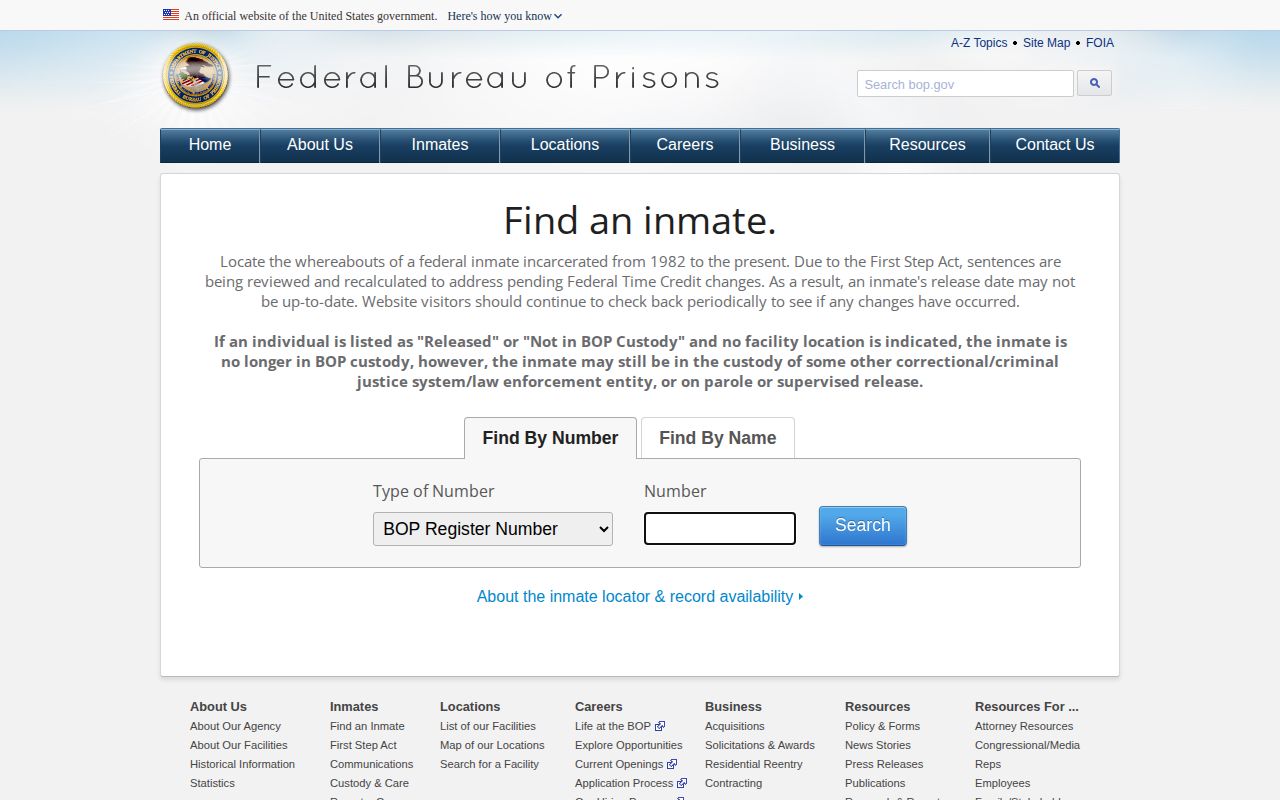
The federal label must still be checked against the federal court case and any immediate transfer to another custodian.
Choose the Correct Custody System
| System | Best use after custody changes |
|---|---|
| Guadalupe jail / GCSO Records | Actual county release time, type, bond, and receiving agency |
| Tyler and county clerks | Judicial reason, docket, judgment, and later disposition |
| TDCJ | State intake, projected or scheduled dates, parole status, and discharge history |
| IVSS Counties | Timely county custody-event notice for a named person |
| BOP / ICE / USMS | Federal prison, immigration detention, or federal pretrial paths only |
Guadalupe Custody and Supervision Map
- Guadalupe County Adult Detention Center: county booking, release, bond, and transfer records.
- Guadalupe County Juvenile Facility: restricted juvenile placement, separate from adult search channels.
- Seguin District Parole Office: state parole and mandatory-supervision routing, not a jail.
- Guadalupe County Adult Probation: local probation and pretrial supervision through CSCD.
- Texas Department of Criminal Justice: statewide prison, state-jail, release, and discharge records.
- Federal Bureau of Prisons: nationwide federal custody and historical release results.
Cross-Check Dates and Outcomes
Three dates can describe the same custody change without matching. A judge may sign an order first, jail staff may finish release processing later, and an electronic service may post the event after its own update cycle. Record each label, source, and timestamp instead of selecting the earliest date. When an exact departure time matters, the booking/release sheet controls the county-jail question. The docket explains the legal authority, while an IVSS alert supplies timely but informational notice.
Identity matching deserves the same care. A common name in Tyler Public Access may return several people or several episodes for one person. Match the cause number, booking number, date of birth when lawfully available, approximate dates, court level, and charge history. Avoid publishing protected identifiers merely to show that a match was made. For TDCJ, a TDCJ or SID number is more reliable than a name search. For BOP, the register number provides the best link to the federal record.
Custody language also has consequences. “Time served” concerns satisfaction of a confinement term recorded by a judgment or order. “Parole” and “mandatory supervision” describe release from an institution under state supervision. “Discharge” generally means the sentence has ended under the responsible agency's definition. “Transfer” is continuous custody. “Released” in a federal locator does not establish that no state, local, or immigration authority took custody next. Keep those distinctions intact when saving or describing a record.
If sources disagree, use the discrepancy to choose the next custodian. A court order without a jail departure calls for Jail Records. A county transfer without a TDCJ result may reflect intake lag, so recheck after a working-day update and call the receiving agency. An IVSS event that says transfer should never be rewritten as community release. A favorable parole vote without a scheduled or completed release remains a processing event, not proof that the person left an institution.