
Guadalupe County Release Date Labels
A Projected Release Date is TDCJ Classification and Records' calculation for release if parole does not occur first. Parole eligibility is only the earliest point when a person may be considered. A Scheduled Release date and location can appear after an approved route has moved through release processing. An actual release or Discharge Date records an event that has occurred. The distinction matters because a future field is not proof that someone walked out.
- Parole eligibility
- The earliest legal point for Board consideration, not a promised release.
- Projected Release Date
- A computed TDCJ date based on sentence and applicable time-credit rules.
- Scheduled Release
- A planned date and location after processing has advanced; it can still change.
- Discharge
- The sentence ends and the person leaves incarceration or supervision under the applicable record.
Find Guadalupe County Projected Dates
First identify whether the person is at the Guadalupe County Adult Detention Center or has entered TDCJ. The TDCJ offender search is correct for state-prison custody and state release history. It is not a county-jail archive. Its fields include last name, first name, TDCJ number, SID number, gender, and race. An identifier provides a safer match than a name alone.
- Confirm the last known custodian and collect the booking, TDCJ, SID, or cause number.
- For TDCJ, search the official form and open the matching detail record.
- Read Projected Release Date, parole information, Scheduled Release, and status by their exact labels.
- For a county sentence, obtain the judgment and jail-credit terms, then ask GCSO Jail Records for an existing calculation.
- For a pretrial case, follow the bond and court docket instead of looking for a sentence date.
TDCJ warns that its public database is updated on working days and is at least 24 hours old. Relatives planning pickup should contact the unit first. If a result is unclear, email pia@tdcj.texas.gov with the full name and seven-digit TDCJ number. If the number is unknown, provide exact date of birth, or approximate age and county of conviction. The no-charge reply may include current and prior incarceration information and the projected date.
The TDCJ offender information landing page identifies the official search and available record types.
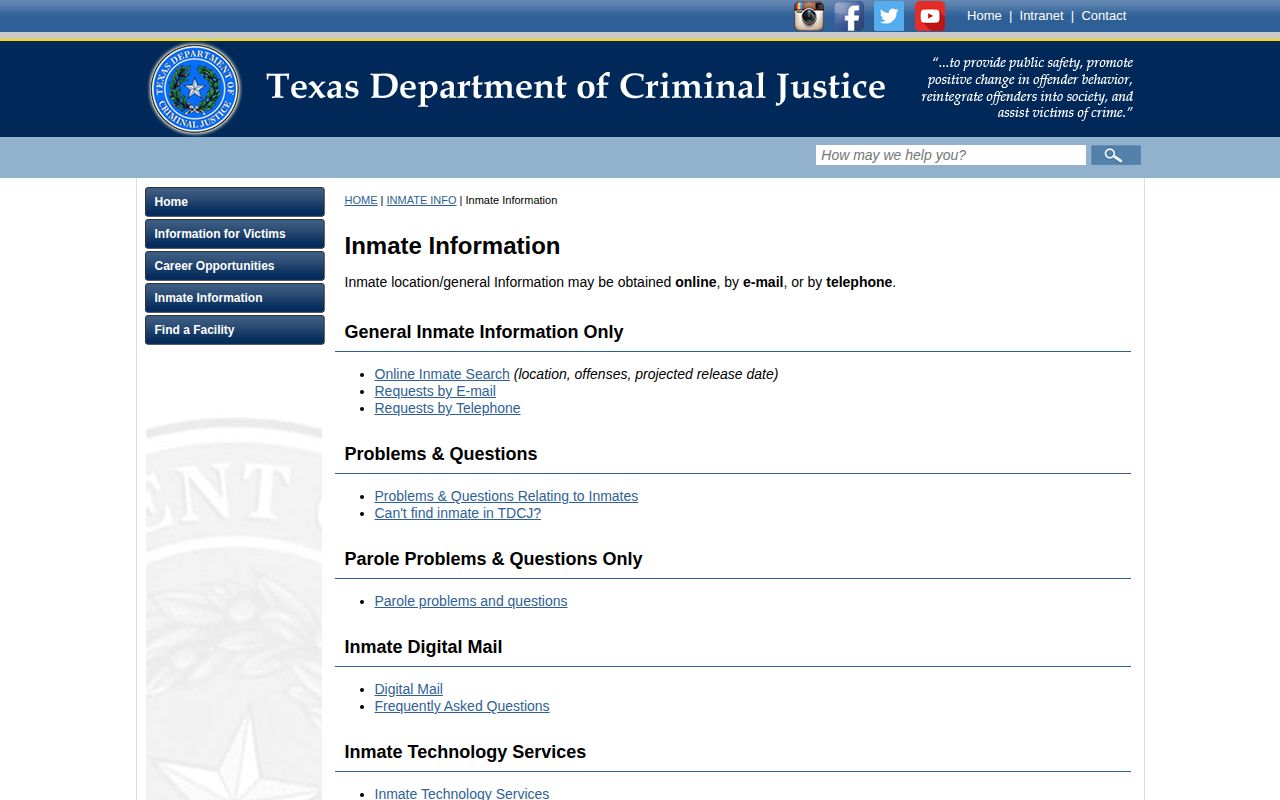
The official landing capture helps separate statewide prison information from a Guadalupe County jail release record.
Texas Projected Release Calculations
TDCJ groups projected-date calculations by offense date and mandatory-supervision eligibility. For an eligible offense before September 1, 1996, flat time plus good time reaching the sentence can set mandatory release if parole has not occurred. For an eligible offense on or after that date, reaching the credit threshold also requires Board approval. A denial may recalculate the projected date to maximum expiration, while a later approval may move it earlier. If mandatory supervision is unavailable, the projected date generally tracks maximum expiration unless parole occurs first.
The TDCJ release and projected-date definitions describe those categories.
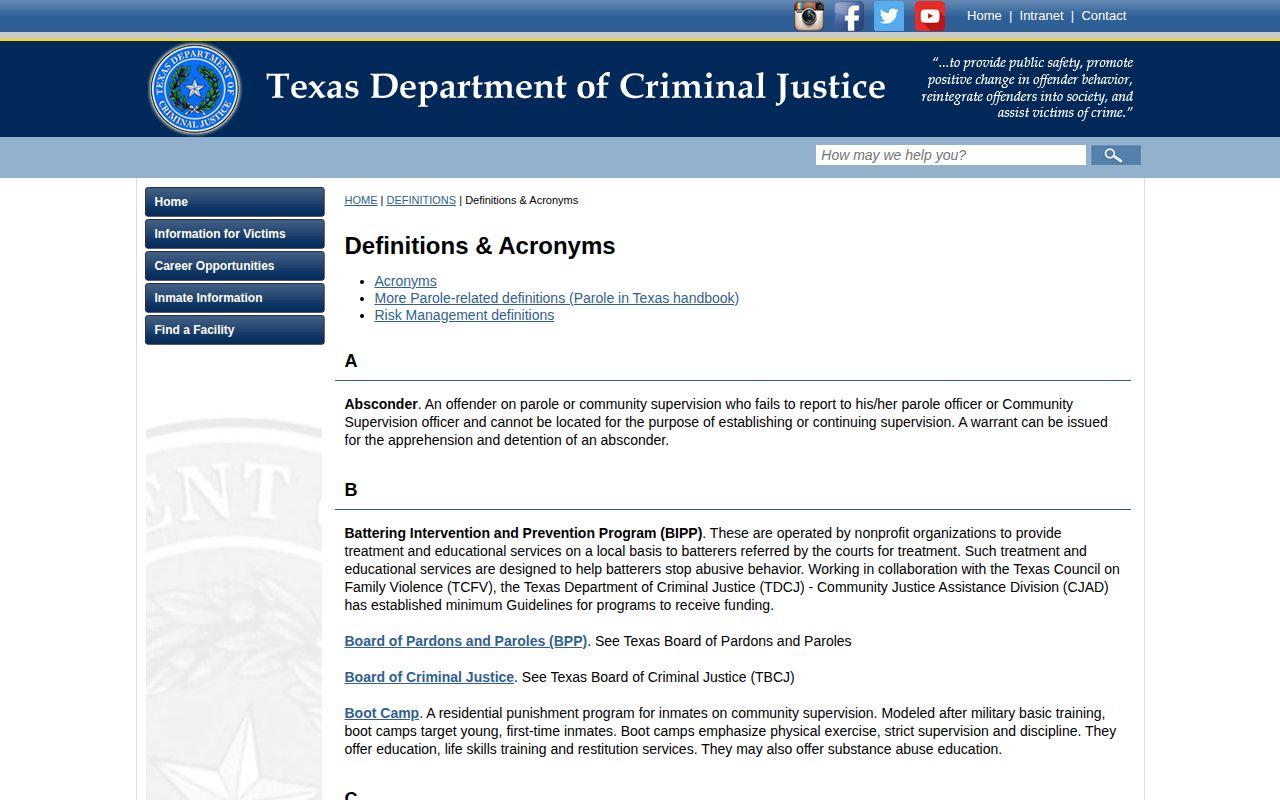
The definitions show why one displayed date cannot be read without the person's offense-date law and eligibility category.
Multiple sentences, jail credit, and amended judgments also matter. Consecutive sentences may move the calculation. A detainer can send a person directly to another agency even when TDCJ confinement ends. Required programs, an approved residence, or special conditions can delay execution of a favorable parole decision.
Guadalupe County Good-Time Rules
Texas Government Code Chapter 498 governs good conduct time. TDCJ classifies prisoners and awards credit based on classification, conduct, work, obedience, and program diligence. Credits can be forfeited or affected by reclassification. Good time affects eligibility and calculations only where the law lets it count. It does not rewrite or shorten the sentence imposed by the court.
A fixed-percentage web calculator cannot reproduce the official result. The calculation can depend on the offense date, conviction statute, mandatory-supervision status, consecutive sentences, jail credit, disciplinary history, and current classification. It also cannot predict a Board vote. TDCJ's own date is the useful public field, subject to its update lag and later changes.
Note: A projected date is an administrative calculation, while the judgment and applicable Texas statute provide the legal inputs behind it.
No Texas 85-Percent Rule
Texas does not impose one blanket rule that every prisoner must serve 85 percent. Government Code Chapter 508 uses offense-specific and sentence-specific formulas. Under one common provision, calendar time plus allowable good conduct time equaling one-fourth of the sentence or 15 years, whichever is less, can create parole eligibility. Certain listed serious offenses commonly require calendar time without good-time credit equal to one-half of the sentence or 30 years, whichever is less. Special categories have still different rules.
Eligibility is not release. Section 508.149 excludes specified offenses from mandatory supervision and permits the Board decision required in other cases. The Board may find that release would pose the statutory risk or that accrued credits do not reflect rehabilitation. Only the precise offense, offense date, judgment, and current record can identify the rule that applies.
Ordinary Texas parole consideration also does not use a public county hearing calendar. Board panel members review a file and vote. A favorable result can remain subject to residence approval, programs, conditions, certificate work, and audit. Guadalupe County residents should use individual status and decision channels, not a guessed hearing date.
Guadalupe County Jail Sentences
Do not apply the state projected-date field to a person serving only a Guadalupe county-jail sentence. Obtain the signed judgment, sentence start, and jail-credit language from the appropriate court record. Then ask GCSO Jail Records at 830-303-6342 extension 2239 whether an existing time calculation or projected discharge record is available. Staff should not be asked to create a legal calculation that does not exist.
A pretrial detainee has no sentence-based projected date. Departure may depend on a cash, surety, or personal bond, a judge's order, dismissal, another case, or a hold. The court docket can explain an order, but the jail record establishes actual processing time. Weekend and holiday release rules were not published by GCSO, so no special timing should be assumed.
Why Guadalupe Release Dates Change
A date can move because the underlying legal facts, time credits, release decision, or destination changes. The public database can also trail agency action. The most common researched factors are shown below.
| Factor | Effect on release |
|---|---|
| Parole grant and completed processing | May permit release before projected expiration. |
| Mandatory-supervision vote | Approval or denial can move an eligible post-1996 calculation. |
| Good-time loss or reclassification | Changes credit where state law permits it to count. |
| New or amended sentence | Changes the legal inputs, including consecutive terms or jail credit. |
| Detainer or receiving agency | May continue physical custody at a different destination. |
| Program, residence, or condition | Can hold an approved case until requirements are satisfied. |
| Data lag | The public result may be at least one day old and skips nonworking-day updates. |
The TDCJ Review and Release process describes the work between approval and departure.
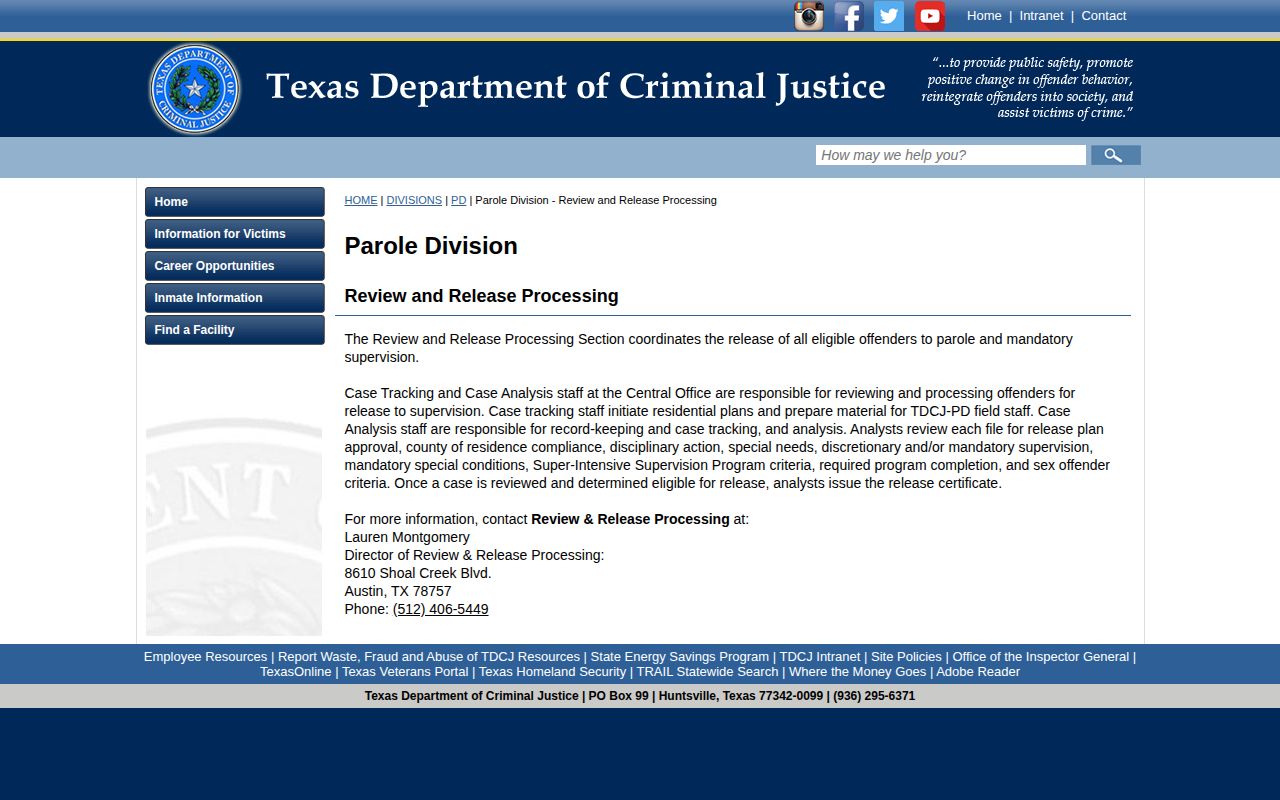
The capture makes clear that a favorable Board vote is one stage, not the final physical release event.
Confirm Guadalupe County Release Dates
For a state prisoner, recheck the official detail, then use the proper status line. Before a Board vote, call BPP at 844-512-0461. After a favorable vote, call the TDCJ Parole Division at 512-406-5202. General location and information lines are 936-295-6371 and 800-535-0283. Callers need a TDCJ or SID number, or an exact date of birth.
For county custody, use the jail and court record. For prospective notice, the Guadalupe County VINELink Release Check explains county and state IVSS layers. An alert remains a lead. The strongest confirmation is the final record from the agency that physically held or supervised the person.
Guadalupe Parole Review Timing
The Texas Board of Pardons and Paroles makes release decisions, while TDCJ processes an approval and supervises a releasee. TDCJ identifies cases before eligibility, an Institutional Parole Officer prepares a summary, and a three-member panel votes in sequence. Two matching votes decide the case. Approval codes may require a future date, transfer, or program, while a denial can set another review or require service of the sentence.
That process explains why eligibility, a vote, and physical departure can be months or stages apart. A Board outcome can also be withdrawn when new information appears. Read the current result code from the official record and then call the post-approval status line. Do not add a guessed release date to a Guadalupe case based only on the usual review cadence.
The BPP voting options identify the current result codes.
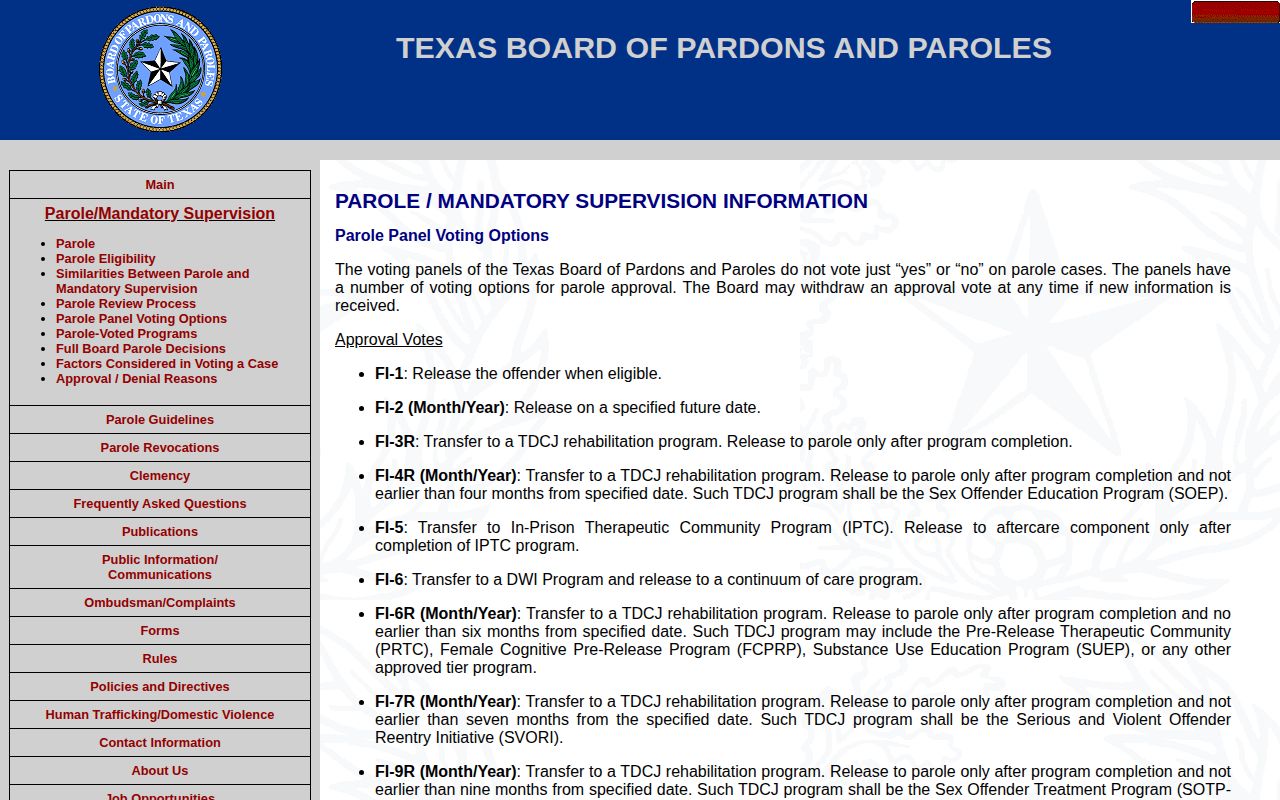
The official capture illustrates why the result code must be read before estimating when release processing might end.