
Guadalupe Parole and Probation
Texas separates parole decisions, parole supervision, and probation. The Texas Board of Pardons and Paroles decides whether an eligible state prisoner receives parole or mandatory supervision. The TDCJ Parole Division then completes approved release work and supervises a releasee in the community. Guadalupe County Community Supervision and Corrections Department, called CSCD, supervises probation imposed by a county or district court. It also operates pretrial services. A probation order is not a parole grant.
These labels affect where to verify a record. A TDCJ offender detail and Board status channel are the right starting points for parole. The Guadalupe judicial Public Access portal and the sentencing court record are the sound starting points for probation. The Guadalupe County released-inmate search explains how those records fit with a county jail release sheet.
| Feature | Parole or mandatory supervision | Probation or community supervision |
|---|---|---|
| Source | Release from TDCJ confinement under state supervision | Order entered by a trial court |
| Decision maker | Texas Board of Pardons and Paroles | County or district court |
| Supervisor | TDCJ Parole Division | Guadalupe County CSCD |
| Public verification | TDCJ offender detail, Board status line, then release processing | Tyler court case, judgment or supervision order |
| Local office | Seguin District Parole Office when assigned | CSCD offices in Seguin and Schertz |
Verify Guadalupe Post-Release Supervision
Begin with the legal status, not the nearest office. An office directory proves only that an agency serves an area. For a state case, search the TDCJ offender system by TDCJ or SID number when possible. A name match alone can be wrong. Read each label carefully. Parole eligibility, a Board vote, a scheduled release, active supervision, and discharge describe different stages.
- Determine whether the last custody was Guadalupe County jail custody or TDCJ state custody.
- For a TDCJ case, check the offender detail and its current parole-review or supervision fields.
- Before a Board vote, request status through BPP at 844-512-0461.
- After a favorable vote, check release processing through TDCJ Parole Division at 512-406-5202.
- For probation, find the Guadalupe court case and read the judgment or community-supervision order.
- Use the local parole or CSCD office to route a lawful question only after identifying the supervision type.
A favorable FI or RMS vote is not an actual release record. Residence approval, a required program, conditions, certificate preparation, audit, and eligibility checks may remain. TDCJ's Review and Release Processing page describes that bridge. Physical release is best confirmed after the offender record changes and the correct supervision path becomes clear.
Guadalupe Release Supervision Offices
Guadalupe County has two local paths. The Seguin District Parole Office serves TDCJ parole and mandatory-supervision work in its assigned area. Guadalupe CSCD handles court supervision through offices in Seguin and Schertz. Staff may route a question, but protected case details may not be disclosed. Use the official offender or court record first and ask for only the public verification needed.
Local supervision contacts
Seguin District Parole Office
11010 FM 725, Seguin, TX
830-303-4906
Guadalupe County CSCD, Seguin
209 E. Donegan, Seguin, TX
830-379-7270; metro 830-303-0058
Guadalupe County CSCD, Schertz
1052 FM 78, Suite 105, Schertz, TX
210-945-8280
The official Region IV office directory shows the Seguin parole office. Its placement in Guadalupe County does not mean every person released in the county reports there. The approved residence and TDCJ assignment control the supervision office.
The official directory view shows the local state office used for routing parole questions.
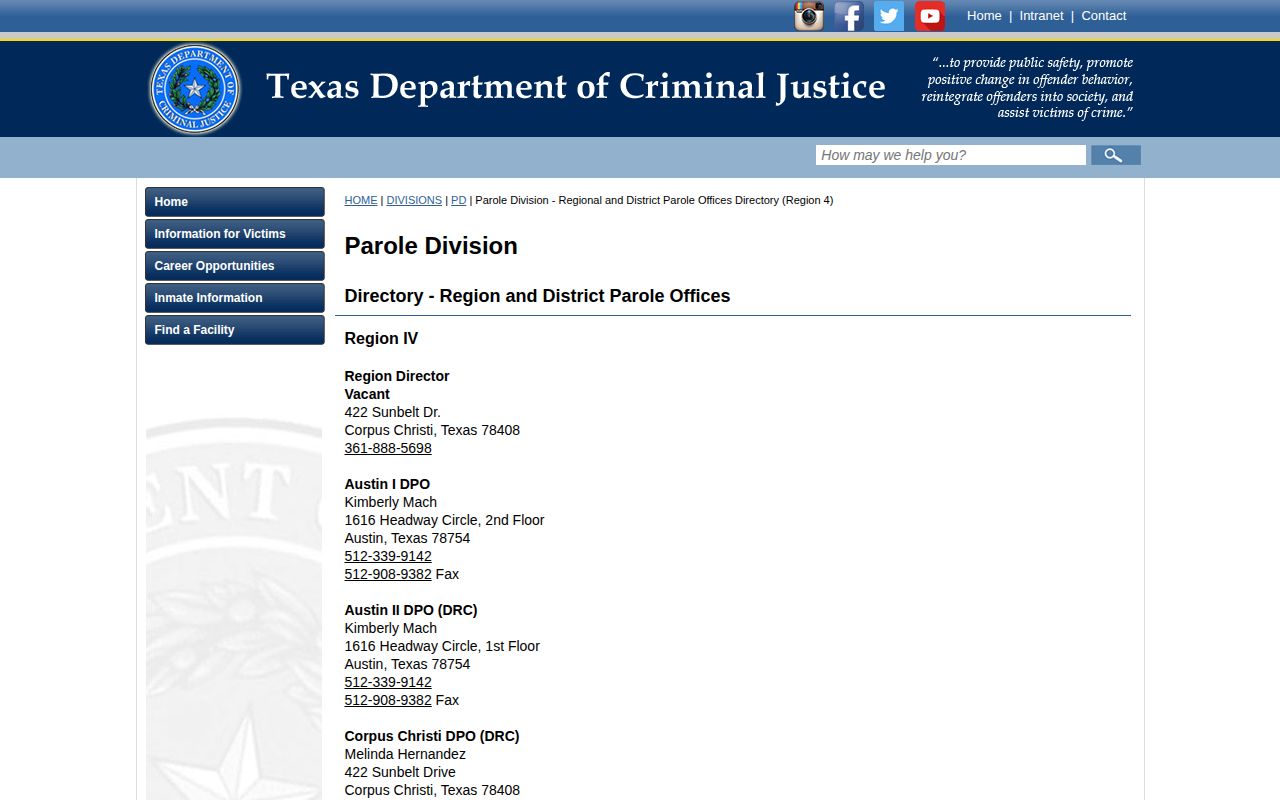
This listing should be paired with a current offender status, not treated as a public roster of releasees.
Guadalupe Probation Release Intake
Guadalupe CSCD publishes a local instruction that makes the probation route unusually clear. Under the stated standard condition, a person must report at the Seguin office immediately after the court appearance or within 24 hours after release from custody. Staff then complete intake and schedule a meeting with the assigned officer. This direction belongs to probation cases governed by that condition. It must not be copied onto a parole case.
The Guadalupe CSCD FAQ is the source for this post-release reporting step.
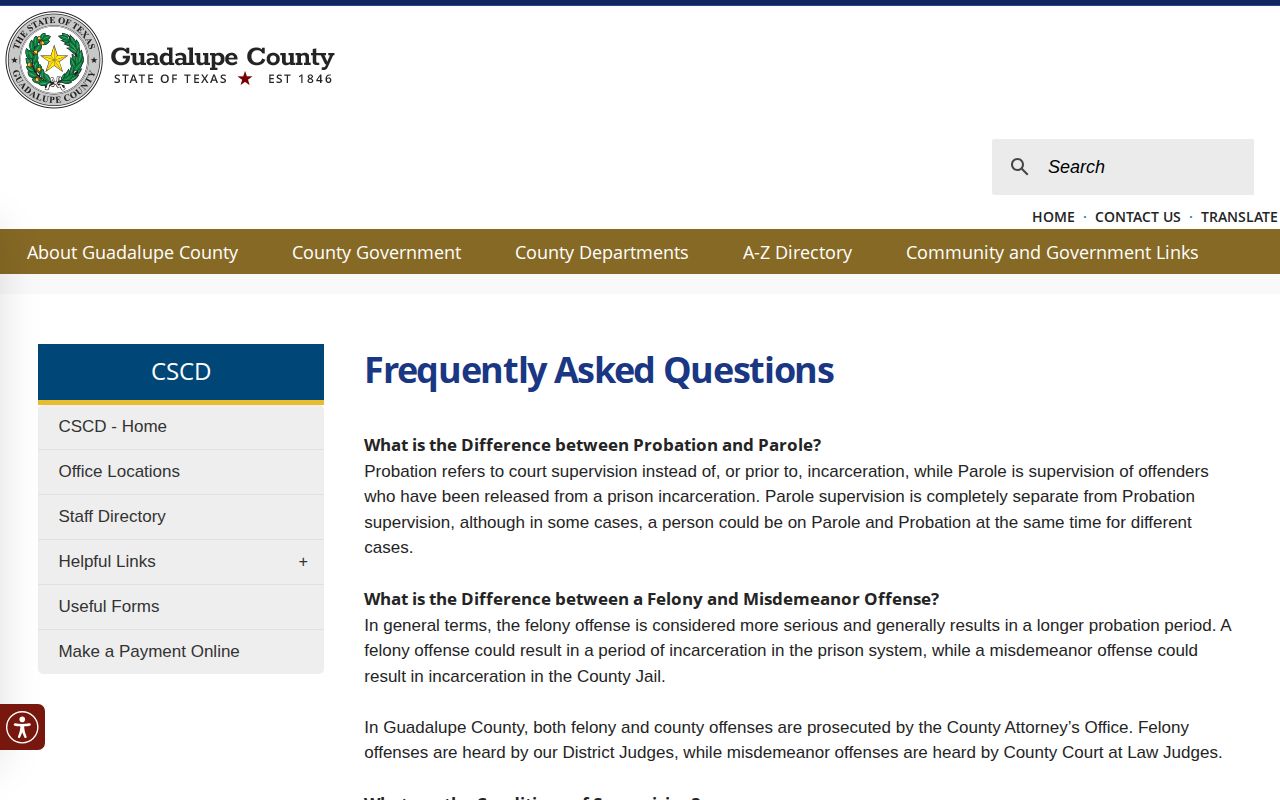
The instruction explains what a supervised person must do; it is not a public lookup for someone else's status.
For public verification, search the court case by name or cause number and locate the judgment, probation order, later modification, motion to revoke, or discharge entry. County Courts at Law generally hold misdemeanor matters, while district courts hold felony matters. The court record establishes the order. CSCD carries out the supervision.
Guadalupe Parole Review Results
Texas does not hold a formal public hearing for ordinary parole or mandatory-release consideration. Board members review the file and vote individually. TDCJ identifies cases before eligibility, an Institutional Parole Officer prepares a summary, and a three-member panel votes in sequence. Two matching votes decide the case. A split sends the matter to the third voter.
That process means there is no Guadalupe County courthouse calendar for an ordinary state parole review. Before a vote, use the offender detail and BPP status line. After approval, use the TDCJ release-processing number. The BPP Ombudsman page supplies the results route and status contact.
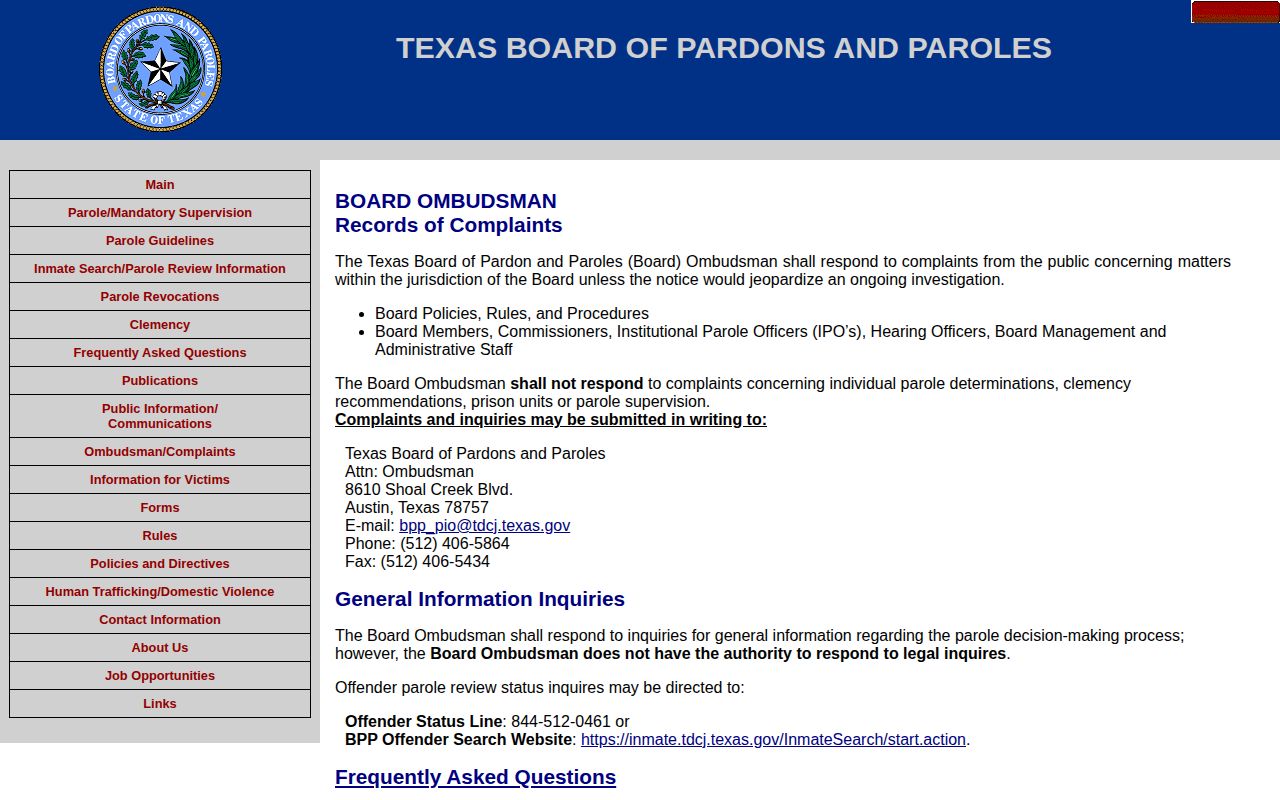
The state result channel replaces a county hearing-calendar search and keeps eligibility, decision, and release as separate events.
Board codes need context. FI approvals can be immediate when eligible or conditioned on a later date, transfer, or program. RMS refers to release to mandatory supervision. NR is a denial with a next-review date, while some outcomes direct the person to serve all remaining time. The Board may withdraw an approval if new information arises.
Guadalupe Supervision and Absconders
Conditions vary by order and case. They may govern reporting, residence, travel, programs, fees, or contact, but only the controlling certificate or court order states what applies to one person. A violation allegation can lead to a warrant and revocation process. It does not by itself tell a reader whether the person is currently in jail, still in the community, or awaiting a decision.
An absconder label means the supervising authority alleges that contact has been lost or that required reporting has not occurred. No general Guadalupe County public absconder list was found. TDCJ provides a Sex Offender Absconder Information Search, but it covers only that defined category. Absence from that narrow tool cannot establish compliance by a parolee or probationer.
For a possible warrant, check the relevant court docket and ask the correct agency for public status. County IVSS Counties may provide major custody-change notifications for a Guadalupe jail episode. TDCJ IVSS is the separate state-prison notification layer. Neither should be used to infer facts that the displayed event does not state.
Guadalupe Supervision Discharge Records
Supervision ends through the action recorded by the agency or court. TDCJ defines discharge as the point when a sentence ends and the person is released from incarceration, parole, or mandatory supervision. A probation discharge comes from the court record and may follow completion, early termination, revocation, or another ordered outcome. Release from a jail is not the same as discharge from the sentence.
Preserve the source and date when checking an old status. TDCJ information can change as processing advances. A Guadalupe court docket may show the supervision order and later discharge, while the local office can route a question about its own process. The strongest conclusion uses the final labeled record instead of assumptions based on a missing jail entry or an old approval notice.
Public Record Search
Sponsored Results