
Guadalupe Adult Probation Role
The Guadalupe County Community Supervision and Corrections Department, commonly called Adult Probation or CSCD, serves the local courts. It supervises community-supervision cases and operates pretrial services. Its offices in Seguin and Schertz are service and reporting points, not detention facilities. An office listing does not prove that a named person has left jail or has been placed on probation.
Probation is a court disposition. A judge may order community supervision instead of, or in connection with, confinement. The judgment and supervision order identify the term and legal basis. Jail Records is still the better source for the actual date and time a person left the Guadalupe County Adult Detention Center. If the person never entered local custody, there may be no jail release event to obtain.
| Record or office | What it establishes | What it does not establish |
|---|---|---|
| Court judgment or order | Community supervision and court terms | Exact jail-door time |
| Jail release sheet | Physical departure, code, and possible destination | Every later supervision event |
| Guadalupe CSCD | Assigned reporting and intake route | A public list of probationers |
| TDCJ parole record | State parole or mandatory supervision | County probation status |
Verify Guadalupe Probation Release
The most reliable path starts in the Guadalupe court case because the court creates probation. The sheriff's “Records Search” page points to Tyler judicial Public Access, which is a case portal rather than a released-inmate feed. County Clerk records cover misdemeanor and county-court matters. District Clerk records cover felony and district-court matters. Search the correct court and verify the name against the cause number and case dates.
- Open Guadalupe judicial Public Access and locate the correct cause.
- Read the judgment, plea, probation or community-supervision order, and later docket entries.
- If confinement preceded supervision, request the jail release sheet for the actual departure date, time, and code.
- Use the Seguin or Schertz CSCD contact shown for the assigned reporting route.
- If the record instead concerns release from TDCJ, switch to the state parole path rather than county probation.
A court order may be signed before jail processing ends, so the date on the order should not be converted into an assumed physical release time. When exact timing matters, pair the court document with the existing booking and release record.
Guadalupe Probation Office Contacts
Guadalupe County publishes two CSCD locations. The Seguin office is the site named in the local intake instruction, while the Schertz office is another county access point used as assigned. Call the office shown in the case paperwork or ask CSCD to route the question. Staff may limit what they disclose about another person's supervision, but they can provide general office and reporting information.
209 E. Donegan
Seguin, TX 78155
830-379-7270
Metro: 830-303-0058
1052 FM 78, Suite 105
Schertz, TX 78154
210-945-8280
The successful manifest image is drawn from the official Guadalupe County CSCD page.
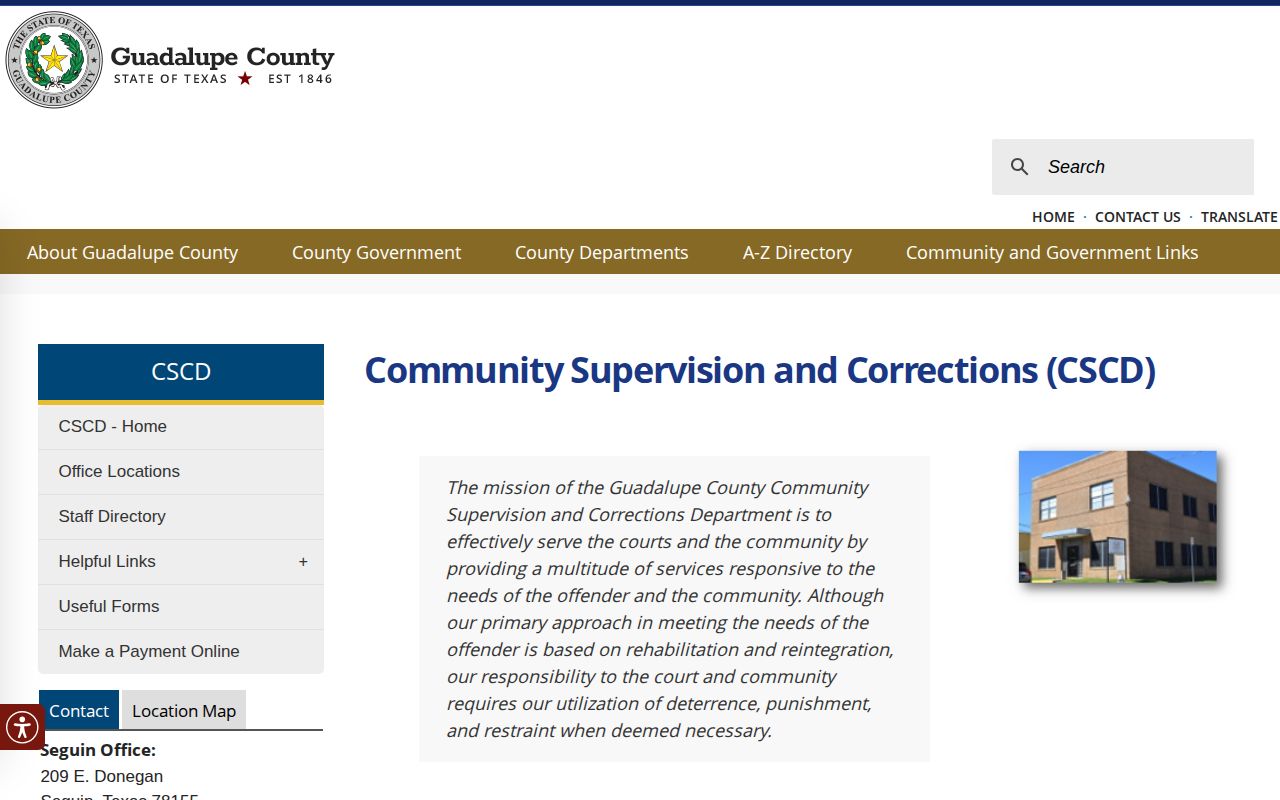
It confirms the two local access points while leaving each person-specific assignment to the court and CSCD records.
Report After Guadalupe Release
The Guadalupe CSCD FAQ gives an unusually specific local direction. A person subject to the stated standard condition must report at the Seguin office immediately after the court appearance or within 24 hours after release from custody. The purpose is to complete intake and schedule a meeting with the assigned officer. This is a direction to the supervised person, not a public release alert.
The instruction should be read with care. It does not establish that every person released from the Guadalupe County jail is on probation. It does not apply to state parole cases, whose reporting terms come from TDCJ. Nor does it mean that the CSCD front desk can confirm a jail release to any caller. The order, jail sheet, and agency instruction each answer a different question.
The related successful manifest image comes from the official probation FAQ.
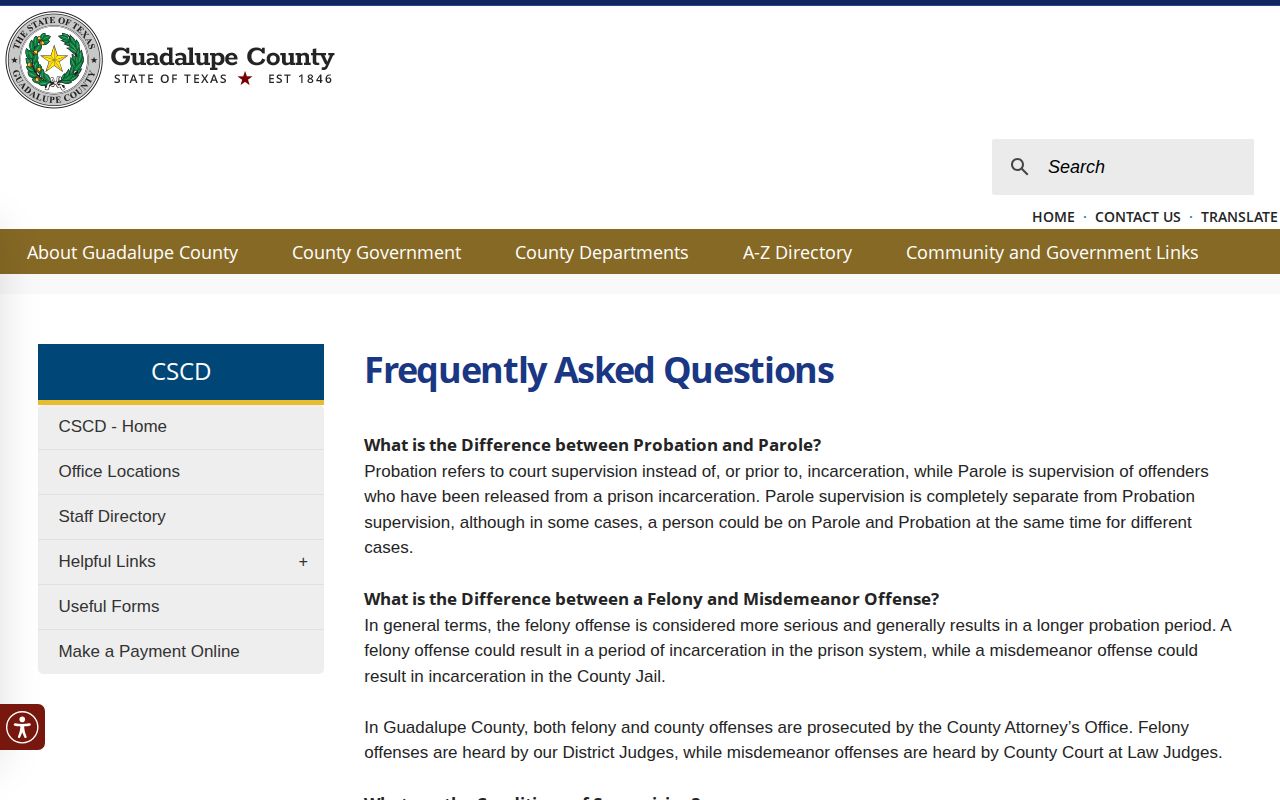
It documents the local intake timing without turning the probation office into a general released-person search.
Note: A person under the published condition should follow the current court paperwork and call CSCD promptly if release occurs outside normal office access.
Guadalupe Probation Record Meaning
A probation record can show the conviction or deferred disposition, the supervision term, reporting requirements, financial obligations, treatment or service conditions, and later court action. The exact public fields depend on the court record and current access law. CSCD case notes and personal supervision details are not automatically public merely because the court docket contains an order.
- Community supervision
- The Texas term commonly used for court-ordered probation.
- Pretrial services
- Monitoring or services before final case disposition, separate from a probation sentence.
- Revocation
- A court process that can change or end community supervision after an alleged violation.
- Discharge
- The recorded end of the supervision term, subject to the court's order.
A motion to revoke, capias, warrant, modification, or discharge entry may appear later in the court docket. An allegation is not the same as a final court finding. Read the chronological record and final signed order. The research found no general public Guadalupe County probationer or absconder list, so one should not be invented from scattered docket entries.
For a full comparison of local probation and state parole, see the Guadalupe County parole and probation resource. Its agency split matters whenever “supervision” appears without a clear label.
Probation and Jail Records
A person may receive probation at sentencing after being out on bond, after serving some jail time, or through another court process. The court file explains the legal outcome. If a specific Guadalupe County jail stay occurred, the release sheet links that booking episode to an actual departure. It can also prevent a court event from being mistaken for the moment the jail released the person.
For the jail record, ask GCSO for existing documents tied to a name, booking number, cause number, and approximate dates. Useful fields include booking date, actual release date and time, release type, authority, and destination or receiving agency if maintained and public. The Texas Public Information Act permits requests for existing records but does not require an office to create a new analysis.
The County Clerk can help with misdemeanor matters at 830-303-8861, and the District Clerk Criminal/Collections contact for felony matters is 830-303-8875. Both main offices are at 211 W. Court Street in Seguin. Their records can persist after a live custody entry ends, making them valuable for confirming why supervision began.
When Probation Status Changes
Probation does not remain static. A court may modify conditions, issue or withdraw a warrant, continue supervision, revoke it, or enter a discharge. A person can return to custody after an alleged violation, but only the current jail and court records explain the actual status. An old probation order should not be treated as proof that the person remains in the community today.
If a search fails, check spelling, cause number, and whether the case belongs with the County Clerk or District Clerk. Legal restrictions can also affect access. Texas expunction and nondisclosure rules can remove or limit qualifying records. Juvenile matters have separate confidentiality protection and should never be routed through Adult Probation merely because the person later became an adult.
The statewide TDCJ offender search belongs only in a state-custody or parole path. A Guadalupe County probation case can exist without any TDCJ prison record. Keeping court, jail, probation, and parole systems separate produces a more accurate account of what happened after release.