
Guadalupe 72-Hour Release Availability
The Guadalupe County Sheriff's Office does not publish a verified official rolling 72-hour release list in the sources inspected. The sheriff navigation, Adult Detention page, Records Search link, county services, and focused recent-release searches produced no three-day feed. Records Search instead opens the county's judicial Public Access system.
That distinction matters. A court portal can show an order, bond action, judgment, sentence, or later case event. It is not a chronological jail-out report. With no published feed, no claims can be made about its fields, refresh schedule, retention period, photos, or weekend roll-up.
Request Guadalupe Three-Day Releases
A useful request sets exact beginning and ending dates, identifies the Guadalupe County Adult Detention Center, and asks for an existing release report if one is maintained. The Texas Public Information Act gives access to existing public information. It does not require staff to answer questions, research multiple systems, or create a custom spreadsheet that the agency does not keep.
- Write the start and end date, including the intended time zone if the boundary matters.
- Ask for an existing release log, jail-register entries, or booking/release sheets within that period.
- Request actual release date and time, release code, facility, and receiving agency if maintained and public.
- Submit through the official GCSO open-records form, email, mail, or in-person route.
- Use IVSS and Jail Records to check one urgent named-person question while the request is processed.
- Compare each event with the correct county or district court case.
GCSO states a request is generally processed within ten business days, subject to clarification, payment, redaction, and Attorney General review. It lists email at gcso-openrecords@guadalupetx.gov, telephone 830-379-1224, and the records office at 2617 N. Guadalupe Street, Seguin. Requests may also be mailed or delivered. Recheck the official page before relying on an office detail.
Guadalupe 72-Hour Record Fields
The table below describes a focused record request, not an online Guadalupe County display. Asking for existing fields by name helps the custodian locate the relevant record and reduces the chance that a transfer will be mistaken for a release home.
| Field or document | Use in the three-day window |
|---|---|
| Booking number | Keeps separate jail episodes from merging |
| Actual release date and time | Places the departure inside or outside the requested range |
| Release reason or code | Separates bond, order, time served, completion, and transfer |
| Releasing facility | Confirms the county jail was the custodian |
| Destination or receiving agency | Shows whether custody continued elsewhere |
| Cause number | Connects the event to its court record |
| Bond record | Explains a pretrial release without implying case resolution |
Some identifiers may be redacted, and not every desired field is guaranteed to exist or be public. Ask for the record itself. Do not ask the office to decide what the facts mean.
Guadalupe Weekend Release Checks
A three-day span often crosses a weekend. It can catch events missed by a same-day check, but Guadalupe County has not published a weekend release cadence or a special holiday report. Court hours, records-office hours, jail processing, and data updates do not share one clock. A signed Friday order might be followed by a later physical release. A Monday court entry can describe an earlier event.
Start with IVSS Counties for a specific person's major custody-status change and call Jail Records at 830-303-6342 extension 2239. Then obtain the release sheet. If speed matters more than the broad three-day group, the Released Last 24 Hours page narrows the same official verification routes.
Guadalupe Records Search Quirk
Guadalupe's most important local quirk is the label “Records Search.” It sounds like a jail-history tool, but the official link leads to Tyler judicial Public Access. The portal can preserve case information after a live custody entry is gone. It cannot be presented as a sheriff list of releases over the prior three days.
The official Guadalupe court directory helps route a case to the proper local court and clerk.
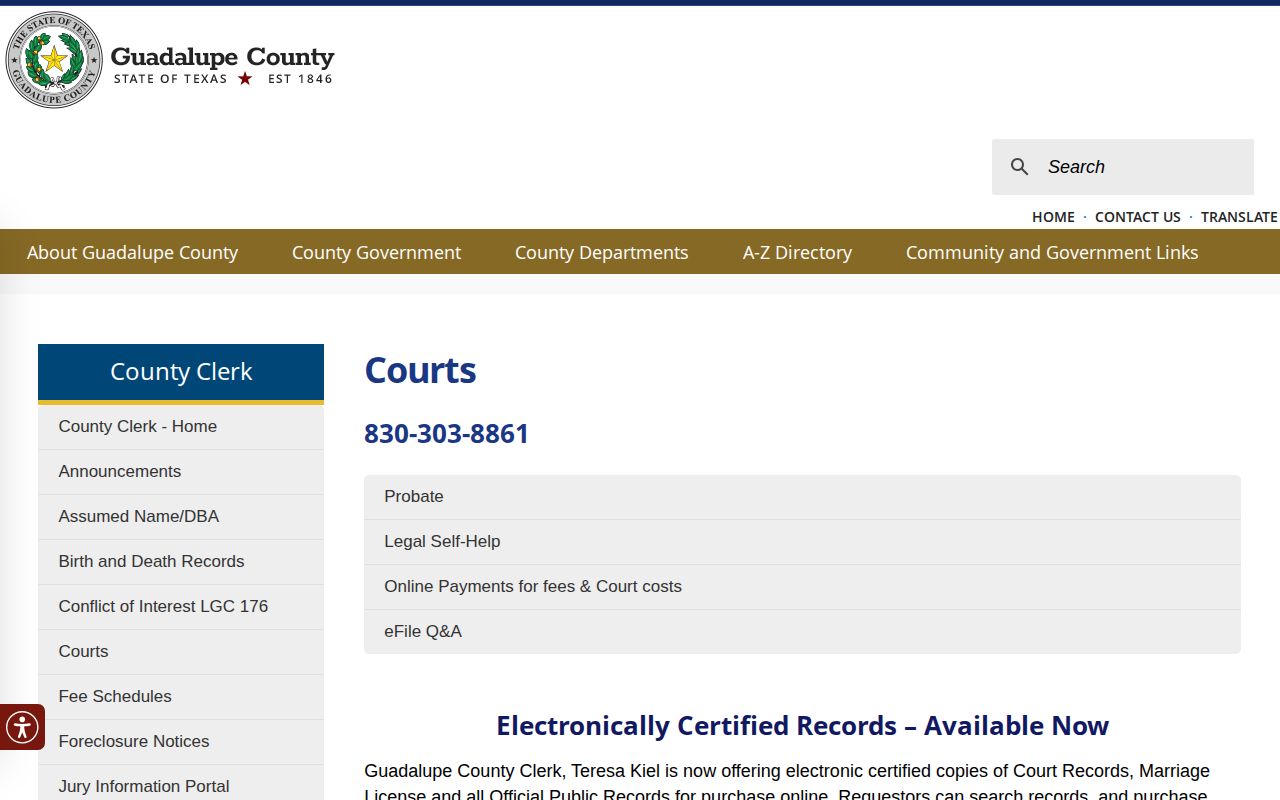
The directory supports the court follow-up step, while GCSO remains the source for an exact county jail release time.
County Clerk and County Courts at Law handle misdemeanor records. The District Clerk and district courts handle felonies. Search by name and cause number, verify the identity, and read the docket in order. Bond returns, judgments, jail credit, dismissals, probation orders, warrants, and discharge entries can clarify why custody changed.
Guadalupe Release Data Lag
A missing name has at least five possible explanations. The person may have entered the community, transferred to TDCJ, transferred to another county or agency, fallen within a data lag, or become subject to a restriction or expunction. The three-day window does not resolve those possibilities by itself.
IVSS is useful for timely custody events, yet it is not a certified release archive. Its message may say transfer rather than release. A court order can show legal authority but not the moment jail processing ended. The county release sheet brings together the booking episode, out time, reason, and destination.
If the person entered TDCJ, allow for intake and working-day updates. The TDCJ public search warns that data is updated on working days and is at least 24 hours old. Use TDCJ only for state custody, not as a Guadalupe jail archive. BOP handles federal prison records, while ICE and USMS serve their own limited jurisdictions.
Guadalupe Three-Day Confirmation Chain
Confidence grows when independent records agree. For one Guadalupe jail episode, pair the actual GCSO release record with the related court record. Add the IVSS event when it exists. If the jail code says transfer, follow the receiving agency instead of calling the person released into the community.
For a three-day group, keep each booking episode separate. A person may have more than one event near the range, and a release followed by a new arrest is not captured well by a single current-status check. Use booking numbers and cause numbers to avoid combining events.
The Guadalupe County released-inmate search covers the full custody-specific path for a named person. Its key rule also applies here: identify the last custodian first, then use that custodian's records and the matching court.
Guadalupe Release Record Retention
No official online-display period was found for Guadalupe County released bookings. Texas records schedules still provide a useful floor. The jail register is permanent and includes core intake and release or transfer information. Booking in/out forms, commitment documents, and release or transfer orders must generally be retained for at least two years after release or transfer.
This rule does not guarantee that records stay on a website. It also does not mean every part is open without redaction. It does explain why a written request can work when a three-day event is no longer visible in a current system. Property records have their own retention rule; the jail's 30-day transferred-property rule is not a release-data rule.
Public Record Search
Sponsored Results