
Juvenile Facility Release Limits
The official Guadalupe County juvenile facilities page identifies this location as a 35-bed, pre-adjudication detention facility used for temporary placement. “Pre-adjudication” means the young person is held before the juvenile court has made a final disposition. It is not an adult county jail, a state prison, a parole office, or a public released-person database.
A juvenile may leave detention through a court-authorized return to a parent or guardian, placement in another program, transfer, or another order allowed in the case. The public cannot infer which event occurred just because an adult roster shows no name. In fact, the absence is expected because juvenile information does not belong in the adult jail search path. Authorized family and counsel should obtain the exact instruction from the juvenile authority handling the case.
| Question | Correct Guadalupe County route |
|---|---|
| Is an adult still in county jail? | Adult Detention Division and Jail Records |
| Was an adult released or transferred? | Adult jail release sheet, IVSS Counties, and court case |
| What happened in a juvenile case? | Juvenile facility or court, limited to authorized access |
| Did a state prisoner leave TDCJ? | TDCJ offender information and release records |
The separation protects young people and also prevents false matches. A person with a similar name in adult search results is not evidence about a juvenile case.
Confirm Juvenile Facility Release
There is no public Guadalupe County juvenile release roster documented in the research. Neither the sheriff's adult custody channels nor a public recent-release list should be presented as a substitute. The sound process begins with legal authority to receive information. A parent, guardian, retained or appointed lawyer, or another person recognized by the court may have a proper reason to ask, but the facility decides what it can disclose under current law and the case order.
- Identify the juvenile facility and case, without posting the child's name or personal facts in a public forum.
- Call the facility administration line and explain the caller's relationship to the child.
- Have the court or case number and proof of identity or authority available if the office requests them.
- Ask where an authorized release or placement instruction is documented and which court office controls access.
- Follow the receiving placement or supervising agency only when the juvenile authority confirms that handoff.
A court hearing date or order can explain the legal action, but it should not be turned into a public claim about a child's physical release. The facility and court remain the authoritative sources for those who are lawfully entitled to the information.
Juvenile Facility Contact Route
The research identifies an administration telephone on the official county page. It does not supply public release hours, a public records counter for juvenile names, or a public online release feed. Callers should ask for routing, not demand confidential facts. Staff may need to verify the caller and direct a legal representative to the court or probation office connected with the matter.
Administration: 830-303-1274 ext. 5226
Official information: Guadalupe County Juvenile Services
Public release list: none documented
The official facility source is shown in the successful manifest image below. The county juvenile facilities page establishes the site's identity and limited role.
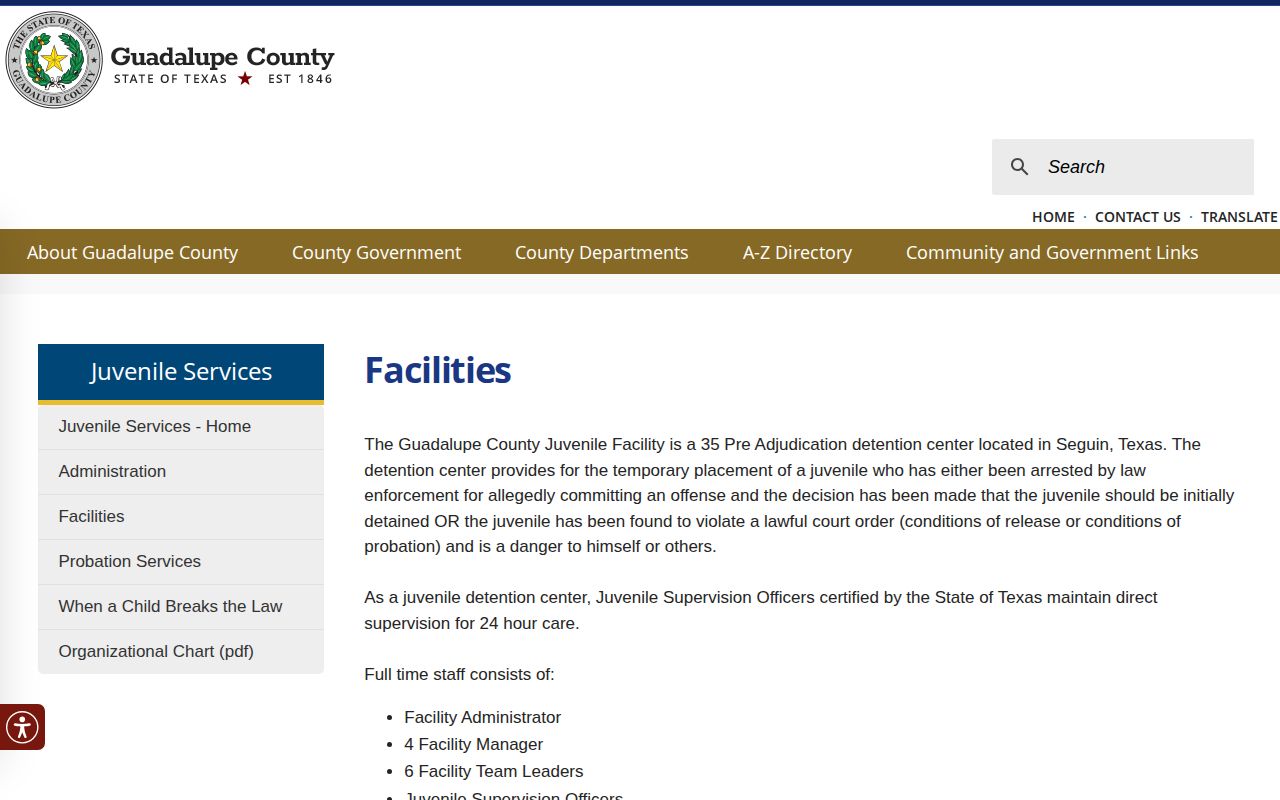
The image reinforces why adult booking, release, and mugshot instructions do not belong on this facility's record path.
The Guadalupe County Sheriff contact page may identify the adult law-enforcement office, but that does not move juvenile records into the sheriff's adult disclosure route. Ask the juvenile facility which custodian holds the exact document and what proof is required.
Juvenile Records Stay Separate
Texas Family Code Chapter 58 governs important juvenile confidentiality issues. That legal boundary is more than a technical detail. Adult arrest and release records often use public-information procedures, court portals, and custody notifications. Juvenile files can include protected law-enforcement, court, social, educational, or treatment material, and public access is not assumed.
The Guadalupe County Adult Detention Center creates adult booking records through searches, fingerprints, and photographs. Its Jail Records line and open-records process can be useful for an adult booking episode. Those facts should never be copied onto the juvenile page as though the same publication rules apply. An adult request sent to the sheriff may be redirected, denied, or narrowed when the subject is a child.
- Pre-adjudication
- The stage before a juvenile court reaches its disposition in the case.
- Temporary placement
- A detention setting that is not itself proof of a final sentence or long-term destination.
- Authorized person
- A caller or requester whose identity and legal role permit access under the case and current law.
- Confidential record
- Information that is not open to general public inspection even if a government office holds it.
Juvenile confidentiality also means old adult-search habits can cause harm. Do not copy a name from rumor, social media, or an unrelated adult record. Use private, official communication and disclose only what is needed to solve the immediate custody or case question.
Adult and Juvenile Boundaries
The facility map includes the juvenile site so readers do not call the adult jail by mistake. It does not turn the juvenile facility into a released-inmates source. Adult local custody belongs to the Guadalupe County Adult Detention Center. State prisoners belong in TDCJ systems. Federal prisoners belong in the BOP locator. Probation and parole offices supervise adults in the community but are not detention centers.
Those boundaries matter when a handoff occurs. A juvenile court may authorize return to a guardian or placement elsewhere. An adult jail may transfer a detainee to TDCJ. TDCJ may later release a person to parole. The word “release” therefore must remain tied to the custodian and record that used it. For a child, only the authorized juvenile source should define the event.
General adult coverage remains on the Guadalupe County released inmates home page. It explains adult jail records, IVSS, court records, and state or federal routes. It should not be used to bypass juvenile limits.
Note: No in-county TDCJ, BOP, or dedicated ICE prison was found, and none of those systems replaces the confidential juvenile channel.
Reading a Juvenile Court Event
A court order and a physical custody change are related but distinct facts. An order may authorize release, direct placement, set conditions, or schedule another proceeding. Processing can follow. An authorized person who needs to coordinate pickup, medication, school needs, or another immediate concern should get direct instructions from the facility rather than infer timing from a docket entry.
Likewise, “released” need not mean that all court involvement ended. The child may remain subject to court conditions, probation, placement rules, or future hearings. Those terms should be read from the governing order and explained by qualified counsel or the responsible juvenile official. The public adult meaning of bond or time served should not be pasted onto a juvenile event.
If an authorized record appears missing, ordinary causes may include a name variation, a case-number error, a restricted interface, or legal confidentiality. The solution is not a scraped copy or public search. Confirm the correct case and custodian privately. When an office cannot disclose details, ask what documentation or court procedure is available to a person with the proper legal role.